
By Jelle Feenstra - 10 December 2025
Delivering as many high-quality seed potatoes as possible. That, in one sentence, is the strategy on the farm of arable farmer Simon Wilms (39) in Anna Paulowna. The mini-crop grower acknowledges that this is an ongoing quest with no ready-made answer. With, among other things, bi-weekly crop guidance, slowly but surely more and more answers are trickling in.
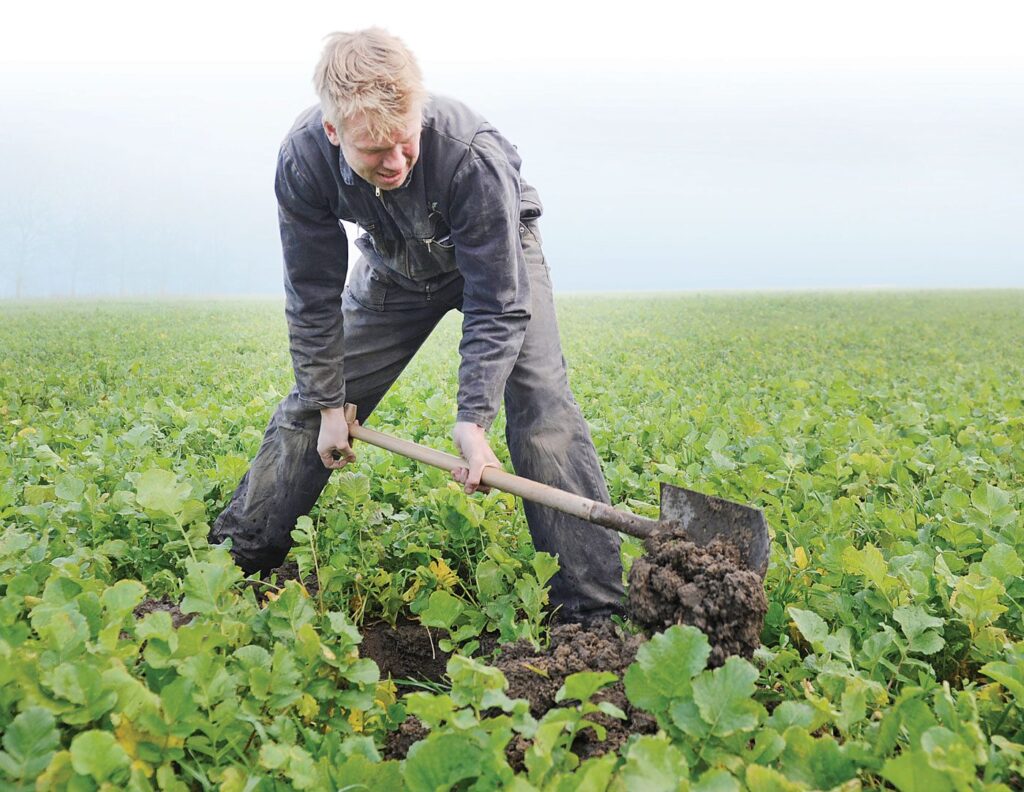
He is busy this cold but sunny December day, arable farmer Simon Wilms. With a shovel, he digs a profile pit in the middle of a green manure field. Together with his crop supervisor from TTW, he can then see whether the soil is compacted or whether the green manure is actually adding more air and structure to the soil, so that he can get even more and better seed potatoes from his fields in 2026. This year, yields in seed potatoes were very good, averaging 55 tonnes gross and outliers to as much as 70 tonnes per hectare. As for quality, the year was more challenging, with high arable pressure and some reductions in class due to virus here and there. But Wilms is certainly not dissatisfied.
‘In terms of growing season, 2025 was two-fingered from start to finish. You could do anything you wanted, we got rain at the right times every time and that resulted in record yields. Only the prices are disappointing, especially those of the free varieties which have more than halved and with which we have now dropped almost to below cost price.’
Mini-tubers and seed onions main crops
Simon is the fourth generation of Wilms on the family farm in the fertile Oostpolder, with easily cultivable light to heavy sandy soil. He runs the business in partnership with his wife Ada (37), who, with her financial background, is keen to help think through financing issues. ‘She can make nice analyses that give me more insight. I mainly do the cultivation technical side, so we complement each other well.’ Simon and Ada own almost 75 hectares of land, lease another almost 35 hectares of ASR land and also rent between 20 and 30 hectares annually. Annually, they grow an average of 45 to 50 hectares of mini tubers in a 1-in-4 rotation. The second main crop is yellow and red seed onions. Of these, they grow between 15 and 20 hectares annually. Another 20 ha of sugar beet and between 30 and 40 ha of summer and winter wheat. They also exchange land with bulb growers or vegetable growers for growing potatoes.
‘Seed potato yields were very good, averaging 55 tonnes and peaking at 70 tonnes per hectare’
The company grows seed potatoes for the trading houses Agrico (35 ha) and Stet (5 ha). In addition, there are 10 hectares of free cultivation, this because of risk spreading. ‘We switched from stem cultivation to mini tubers about 15 years ago. I saw added value in this, precisely because of the favourable location close to the coast, in a real seed potato polder.’ The mini tubers are grown on the farm for up to three, sometimes four years, and then delivered as S as much as possible. Wilms aims for a maximum of five hectares per potato variety. ‘Especially if you grow for the higher segment, I think sufficient risk spreading is healthier for the company.’ In 2025, he grew 13 different varieties and that is actually a few too many. ‘A maximum of 10 is a nice number.’
The grower likes to experiment; it gives him new insights. Like with onion cultivation, which was missing from the cropping plan for years. Highly volatile prices and difficult cultivation deterred his father Henk. But Simon saw salvation in it and kept pushing. ‘That was in 2013. Our business was growing in size, but we only had seed potatoes as a financially strong crop. I wanted to add onions. Then I made a bet with my father: if we manage to turn more than €10,000 balance per hectare, we will continue. That year, we harvested 75 tonnes times 15 cents and just passed the €10,000 mark. So now we grow 15 to 20 hectares of it every year.’
Cultivation guidance gives more insight
For both mini tubers and seed onions, the farmer receives cultivation guidance from TTW. With fortnightly sampling of both crop and soil, adviser Philippe Boutrs maps out what the crop needs and what the soil can provide. This prevents over- and under-fertilisation and ensures efficient use of adjuvants. This year, for example, he advised Wilms to be cautious with nitrogen application, as it was sufficiently available in the soil during the season.
The crop consultant also noticed an above-average presence of the substance molybdenum in the soil, which hinders bulb filling. ‘We then tried to solve this with additional silicon as foliar fertiliser. Thanks to the silicon leaf fertiliser, bulb filling went more smoothly.’
‘That was an eye-opener for me. And in the end, the onions did last a long time,’ says Wilms. ‘Targeted adjustments based on measured deficiencies or, on the contrary, excessive amounts of minerals, nutrients and elements is a speciality of ours,’ Boutrs says. ‘And our fortnightly field visits also make it possible to spot diseases, pests and growth deviations early, on the basis of which the grower can then decide to act or adjust with foliar fertilisers, trace elements or plant protection product.’
A pair of extra sharp eyes
With crop guidance, Simon Wilms tries to deliver higher yields and ultimately better quality in both potatoes and onions to the market. He especially likes the fact that during the growing season, there are a couple of extra sharp ones keeping a close eye on the state of the crop. You resolve to go into the field regularly, as a kind of agronomist. Only sometimes it still stops there. And the advantage of TTW is that they link a lot of theoretical knowledge to observations in the field. On that basis, they do see certain connections or correlations that can help you further. ’With every new input of information, the knowledge about the crop or soil becomes more reliable and therefore more useful for cultivation,' he thinks.
‘The data can also reveal, for example, bad spots or soil compaction on plots.’ Soon, Wilms and his crop supervisor Philippe Boutrs will evaluate the past crop year and look at the cropping plan for 2026. Based on cultivation history and current soil samples, TTW will then advise on basic fertilisation. And then the new growing season starts, with fortnightly monitoring.
Part teams and part NKG
Simon and his father Henk discuss the trade over coffee. They come to the conclusion that, in the end, the weather always remains boss. ‘We are experimenting with non-return tillage, for example. When it was so wet last year, we cursed that system. But we see in drought conditions that non-inversion tillage actually has its advantages. Because it leaves the natural corridors intact, so that capillary action is better. Because we never know in advance what the weather will do, we now do a bit of everything: one part non-inversion tillage and one part ploughing, so we spread the risks, based on the best possible assessment of what conditions will allow and for which crop. What they have stopped doing altogether is ploughing in the furrow. ‘With that, in our experience, you slip up the natural corridors created by the roots of the green manure too much. We bought a four-crown top-over plough.’
‘I think it's sustainable if we get the highest possible yield per square metre’
In 2015, they built a new storage shed. The six storage cells accommodate 2,200 crates. Two cells are equipped for drying and storing some 720 tonnes of seed onions. The other cells are suitable for drying, storing and cooling some 1,500 tonnes of seed potatoes. Last year a new processing line with an optical grader, Tolsma's Optica Q, arrived. And they invested in the purchase of nearly 20 hectares of ASR land, which they financed from Rabobank's €3 billion sustainability fund. These are nice, straight plots of 200 by 500 metres. Wilms speaks of a good, value-proof investment.
Looking to the future
That more and more farmers are quitting, he finds unfortunate. The increasing claims on farmland, discussions on plant protection products, prejudices about the polluting farmer, is it still fun to be a farmer? ‘Definitely it is,’ Simon answers confidently. ‘I definitely think seed potato growers have a good chance. It is one of the few crops in the Netherlands where you can say: we really feed the world with that. Only policy will determine for how many growers that is. And I will always continue to fight for as much arable land as possible. Because I think we are simply a very beautiful agricultural country. With not just practical, but actually a lot of theoretical knowledge that goes around the world. I saw this with my own eyes after visits to India and North Africa, how they can grow good potatoes there thanks to Dutch knowledge and how important virus-free material from the Netherlands is. I find that already a very nice motivation to grow seed potatoes.’
To keep developing that knowledge, Dutch agriculture does need a certain size. ‘I sometimes worry about that.’ From close by, he sees the pressure on crop protection products increasing. I too sometimes have conversations with worried citizens when I arrive with a sprayer. I then try to start the conversation and think with them to the maximum. But also to explain that sometimes it is necessary.‘
Sustainability can be debated, he thinks. ‘I think it is sustainable if we achieve the highest possible yield per square metre, and sometimes that requires a little input of resources. Then you need less land elsewhere and you can free up more land there for nature or other functions. But here the Dutch government wants all functions on all land, so both biodiversity and nature and agriculture. So you actually need more land. And make no mistake, we farmers really do want to move on to cleaner and better, but they have to give us time. If I see how quickly new laws and regulations succeed each other, it's sometimes difficult for an entrepreneur to invest in them. The government should map out a roadmap for the next 20 years much more.’
Record number of kilos eases pain
The financial returns in 2025? ‘The kilos we harvested with record yields more this year are not going to make up for the difference in terms of price drop, especially in the free varieties. Last year, we had a lot of rain in both spring and autumn, resulting in hefty yield losses. But then the payout came, with pool prices of 60 cents and up to 70 cents for the free varieties, and the misery was quickly forgotten. This year, at least, we are happy to have harvested so many kilos, so you might still have a balance. In onions, too, it will be a bit less financially this year. Oh well, I'm just trying to average it, of course we've had some fantastic seed potato years. And those are bound to come again.’
Link to this article in Akker van het Noorden: https://www.akkervanhetnoorden.nl/laatste-nieuws/reportage/simon-wilms-op-zoek-naar-het-perfecte-teeltjaar/?fbclid=IwY2xjawOwkKhleHRuA2FlbQIxMQBicmlkETBnbjJpMTVMSEdQdjNFY1p0c3J0YwZhcHBfaWQQMjIyMDM5MTc4ODIwMDg5MgABHtMCzPXifsPJhXPcUF_aSMpL9KrD3GIx7-8vaxjp1oO5q8HiGATBeKtkndUd_aem_pog6bw7H_KevsQn-cJ9rpg